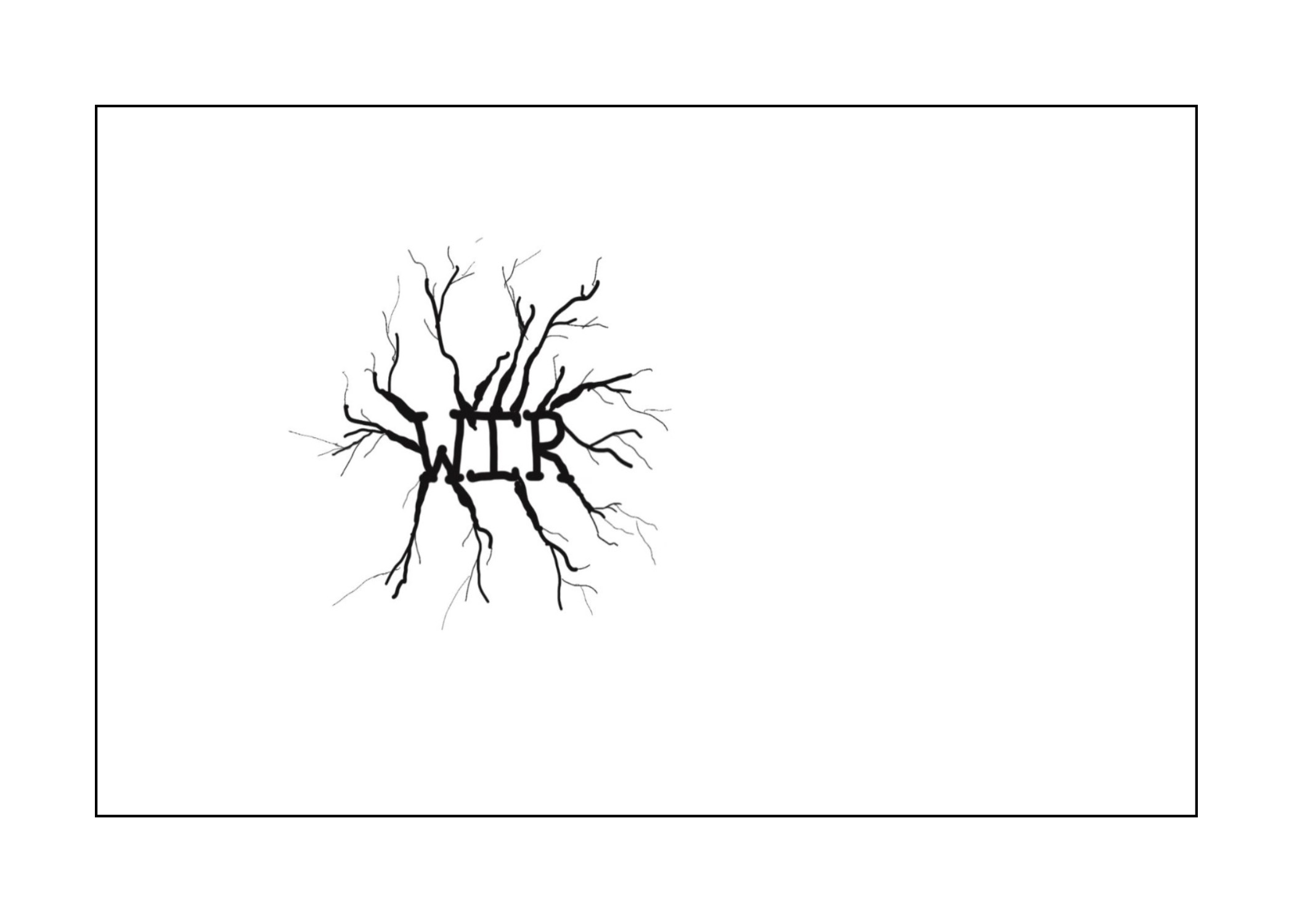
When I was asked to speak about Kafka, I knew that there was a particular text that I wanted to talk about—a short parable from Betrachtung [Meditation] (1912) that I have orbited around for many years. Yet I also felt that there was no way for me to discuss this text without talking about teaching. It was the first text I ever taught and, now that I have taught many texts for many years, it still feels like the only thing I ever teach. It occurred to me that Kafka’s aphoristic texts, especially this one, catalyzed processes that became a guide for how to be in the classroom with my students; how to be in relation with text. When I first brought this aphoristic prose piece to my students I truly felt confused by it. Although I feel more comfortable with it after years of teaching, this is not because my confusion dissipated into clarity, but because I learned, through repeat visits, to explore its different facets—almost like walks that I have configured through the fog, or through the snow. I would like to read you this text, talk you through it in a way that reflects some of the questions and responses that get raised in my classroom, and hopefully offer interpretations that have emerged through teaching it.
Die Bäume
Denn wir sind wie Baumstämme im Schnee. Scheinbar liegen sie glatt auf, und mit kleinem Anstoß sollte man sie wegschieben können. Nein, das kann man nicht, denn sie sind fest mit dem Boden verbunden. Aber sieh, sogar das ist nur scheinbar.
The Trees
For we are like tree trunks in the snow. They seem to be resting smoothly as if one could push them with a slight nudge. No, one cannot, for they are firmly attached to the ground. But see, even that is only appearance.
trans. Joachim Neugroschel
When I teach Kafka, the question “What is going on here?” can often yield surprisingly fruitful results. I first try to focus on what images the text conjures—how students picture the trees—given that the text repeatedly corrects itself, and offers words that are at once precise and extremely vague. Are ‘tree trunks’ a part of living trees, or are they logs, the trunks of trees that have been cut down, cleared of branches, and lie now as an extracted ‘standing reserve,’ as Heidegger might say? The second sentence indicates that they exhibit one condition, a condition of seeming vulnerability, mobility, and physical fragility—-they “lay smoothly,” as if with one little nudge they could be pushed far away. Yet in the third sentence this verdict seems to be utterly reversed. No, one can’t push them — they are bound fast with the soil. The idea of resting smoothly might bolster an interpretation to the effect that the trunks are disembodied; the little push makes me think of a log that could roll down, or roll away. But the idea of being “fest mit dem Boden verbunden [firmly attached to the ground]” suggests living roots—in which nutrients are being absorbed from (and given back to) the soil, in which the trees are not only alive and healthy, participating in an ecological exchange, but also unmovable, at ease, strong in their place. In true Kafka fashion we have here a double take, one that happens so quickly it’s almost hard to process. The tree trunks appear one way, and when we look again, not only do they look slightly different, they look completely different.
Yet in the text we are not actually looking at tree trunks, or accompanying someone who is. We are with a speaker who names themselves as part of a “wir” [we] that is “wie” [like], a we that is being compared to “tree trunks in the snow.” The double take indicates not an empirical reassessment, but a reassessment of qualities that are being compared. Was the comparison made in order to indicate that the ‘wir’ is in a state of collective vulnerability—disembodied, pushable, ready to roll—or is the ‘wir’ actually the opposite—territorially and ecologically emplaced, implacable in its rooted connection to the soil?
Is each condition weighted with a value judgment? Is being ‘pushable’ undesirable—perhaps the intuitive reading—or can it endow one with lightness, flexibility, and mobility? Is being rooted desirable? Perhaps, but the ominous overtones of the German Boden, ground or soil, one half of the nationalistic trope Blut und Boden [Blood and Soil] could indicate stuckness, an excessive attachment to territorial nationalism that veers into violence. The tension between the sentences indicates to me an uneasiness with the dangers of collectivity, the quickness with which something like exilic vulnerability can transform into territorial nationalism, and vice versa. The bounded “wir” is undefined. Does the ‘we’ refer to a polity of German-speakers, a polity of Jews, or human beings broadly?
The German word Stamm (trunk) has a racial connotation, i.e. as ‘heritage,’ that echoes a similar etymology in modern Hebrew: גזע (geza) means both tree-trunk and race; the word for racist is גזעני, gezoni—which could alternately mean tree trunkist?[2] The Hebrew word geza, like the German Stamm also refers to the grammatical word stem. So both words connect the plant world, the social construct of race, and lexical units. The words also uneasily connect German and Hebrew, languages that were brought together by Kafka himself. (Kafka was keenly interested in Hebrew and began studying it intensively toward the end of his life.[3]) In this sense, the ‘wir’ seems to both claim and disclaim German and Jewish collectivity, to indicate an intuitive connectedness that is accompanied by doubts about tribalistic violence. The text evokes the dangers of German ‘racial’ collectivity and the dangers of Jewish, perhaps Zionist, collectivity, without naming either group explicitly. The double take is more complex than one “negative” image simply moving to one “positive” one. It represents a fundamental uncertainty about the status of the collective wir—are they rooted or not, and is being rooted a good thing or a bad thing? Maybe all of the above: yes and no, good and bad, in each instance.
Kafka’s text exhibits deep hesitation, and gives the sense that collectives can be numerous things at once. This capacity for nuance and uncertainty feels important in the context of the unfolding war in the Middle East, especially the discourse about the war in the United States and outside Israel-Palestine. In my experience, many are fixated on the unqualified justice of their ‘side’ and averse to seeing groups as highly complex, and marked by retrograde, constructive, and emergent tendencies. (How, I often wonder, can we gather the constructive, emergent tendencies of multiple collectives, and allow them to collaborate effectively?) Kafka’s aphorism fiercely preserves uncertainty, something that I see as especially important amidst our culture of stark moral binaries. The increasingly truculent will to certainty has, in my experience, become a threat to liberal education in the classroom, and, I think, poses a threat to liberalism generally.
I press my students to think carefully about the text’s pronouns , which shift as quickly and ambiguously as the comparison itself. In sentence one, the speaker is part of a “we,” wir, that is compared to tree trunks. In the second sentence the speaker refers to the trunks as “they,” sie, a change that simultaneously feels natural and odd. Does the wir become a sie to emphasize that the tree trunks are different from the wir, to maintain a heterogeneous element even while drawing a comparative link? Could the sie represent a step back from the seeming certainty with which the speaker places themself as part of the collective wir (evoking the famous diary quip, “What have I in common with Jews? I have hardly anything in common with myself…”) As Vivian Liska eloquently describes in her book When Kafka Says We, the speaker both inscribes themself into and disidentifies from the collectivity—“the ideal of a homogeneous community is simultaneously an object of longing and an instance of terror” (Liska 20).
We have one more dizzying pronoun shift, when the speaker introduces man—the one—who could, with a small stimulus, push the trunks away. Kafka’s phrasing—the littleness of the push, and the suggestive almost of the conditional—places us in the perspective of man, the one who is looking onto the trunks and considering whether or not to give them a nudge. The shifting pronouns indicate, even more than an ambiguity as to whether or not one is ‘in’ or ‘out’ of an identity group, a dislocated perspective in which the speaker evokes both the passive collectivity and the active individual. The speaker is part of the (vulnerable or implacable) collective, but they are also looking at this collective from the outside—assessing what it’s made of and what one could or could not “do” to it.
What do we make of the last sentence that seems to wipe away all the associations we’ve built up, like shaking an etch-a-sketch—Aber sieh, sogar das ist nur scheinbar? After much visual straining, we finally have an imperative that calls on us to see. It is not an image that clarifies our uncertainty, but rather a seeing that dissipates all into the status of “appearance.” Heidegger and Gadamer both celebrate the multiple meanings of the German schein, which could mean shine or seem.[4] They emphasize the unique status of the literary text, which “stand[s] there confronting our understanding with normative claims, and stand[s] continually before every new way the text can speak” (Gadamer, Text 183). Scheinbar most intuitively translates to ‘apparently’ or ‘seemingly’ but could, with a stretch, also be construed as ‘shine-able.’ The “nur scheinbar [only appearance]” is a dismissal of the hunt for the proper comparison, a giving up on the idea that any comparison could match reality, or that the dynamics of collectivity the speaker seeks to compare are accessible. Scheinbar is the last word of the aphorism and the first word of the second sentence, creating a kind of scheinbar sandwich that encases all elaboration of the opening simile in uncertainty. Yet the ‘nur scheinbar [only appearance]’ could also be a presencing within fogginess, something that shines and that we shine, even if we can’t get ‘inside it.’
I usually ask my students, toward the end of our discussion, how to interpret this text as a text about interpreting texts. What often comes up is the notion that the text replicates the course of our discussion. We’re interpreting it this way, is that right? No we’re interpreting it that way, is that right? No! None of these interpretations are right—it’s not like that at all. We haven’t gotten anywhere after all this nitpicking, rethinking, rephrasing—we just can’t access the text—it’s too obscure and its author is too unsettled, too filled with contradiction. Yet there is at the same time a feeling of some kind of opening—a seeing of the “nur scheinbar [only appearance]”—a sense that all the detours “add up” to something, maybe even something that shines, even if, paradoxically, our ‘seeing’ is a mode of being with and probing an obfuscating white “snow,” the snow that covers up our ability to see “roots” with our own eyes.
Could the snow be the white of the page, covering up the roots of the black lettered words? This makes me think of the Rabbinic Midrash that Gershom Scholem cites about the Torah being written by God with black fire upon white fire—the white fire being the “written Torah in which the letters are not yet formed.” “The written Torah” Scholem writes, “is not really the blackness of the inked writing (already a specification), but the mystic whiteness of the letters on the scroll of the parchment on which we see nothing at all.” Scholem also cites a talmudic tale in which God holds back the Torah from Moses to adorn words with ‘crowns’ that are alternately referred to as קוצים (thorns)–scribal ornaments that God says will inspire “mounds and mounds” of legal interpretations from the future Rabbi Akiva.[5] Kafka’s text invites us to a limit space; it gestures to a place beyond language that words both betray and honor. I think of words’ roots uncannily dangling off them, reaching for somewhere but also damaged, waiting to be repotted and nourished. The words have unseen, indeterminate roots, a surplus that cannot be penetrated. It is our task to suss out this surplus; to dwell with all that is “co-present” with the spoken word, what Gadamer calls “the Open of further speaking” (Gadamer, Language 196).
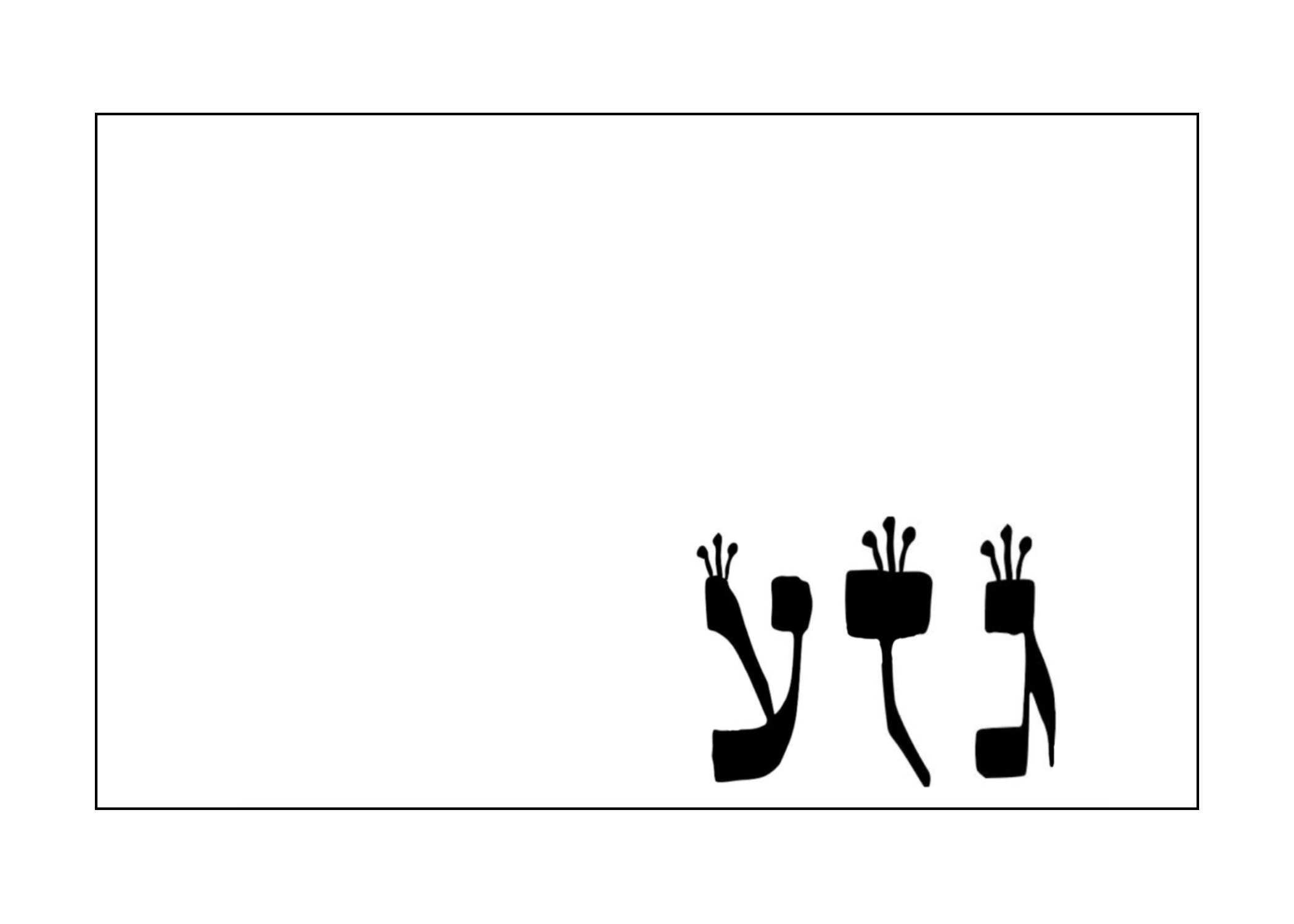
The Hebrew word
‘Geza’ written with tagin, scribal ornamentations
Maybe this text can be pushed, maybe we can run with it, make it our own, take it into the present, into our own historical situation and challenges. Maybe it’s rooted in 1912, maybe we can’t sever its connections to the historical figure of Kafka, writing as a German speaking Jew in Prague during a time of rising Zionist sentiment and rising Czech nationalism. It’s a canonical German text, but, with a little push, is it a “Jewish text”? (‘Jewish’ here meaning not just a language or national tradition, but a wisdom tradition.)[6] The text seems to invite both interpretive tracks—over-historicization and anti-historicization, particularity and universality—wanting us to explore their dangers and pleasures.
A question I don’t normally ask my students, but will now ask myself: Can we interpret this text as a text about teaching texts? Could the ‘we’ be the ‘we’ who sit in a circle and endeavor to understand Kafka, and in so doing, to understand something more about ourselves, and each other? Am I, the instructor, part of the “we” of the circle? Yes and no, the students are still a ‘they’ to me, an impressionable ‘they,’ who set off into far flung interpretations with just the hint of a suggestion. But they are also so themselves, my students, connected fast to the floor in their chairs and not going anywhere, holding their ground. What kind of collectivity are we building as a class that talks through these texts? We belong to a temporary group, and we participate in it while remaining somehow tentative, cautious. We are doing something constructive together, definitely, but…are we really?
In Kafka’s text, information is not being communicated in a direct, linear fashion, as a set of principles. Rather, its meaning accrues through different stations, which we dwell at but do not settle in. The snow is of course also temporal—it will melt eventually, and allow us to see what’s actually happening on the ground, but it will also, hopefully, come back next year. This makes me think of the German use of protocols in humanities seminars, written summaries of the discussion that are then read aloud at the beginning of the next class—a practice I learned about from Professor Steven Dowden at Brandeis University. This active repetition keeps the conversation ongoing and active, layered and accumulative. It reminds us of our paths rather than our conclusions. Kafka leads us to what I could call a dialogical model of teaching, one that seems to leave ever more word material untapped. In the classroom this dialogue is not diadic but plural, one which occurs around a circle (ideally), and in which individual elements bounce off and are bounced off all other individual elements—like a kind of Indra’s net that feels at once precarious and rewarding. Indeterminate roots are roots that have an open ended growth pattern. Like our discussions, like our readings and rereadings, they sprawl, vine, and yield fruit in unpredictable, ongoing ways.